
Stottler Henke Partners with Astrobotic Technology to Run a Fully Integrated Lunar Rover Fault Detection, Diagnosis, and Mitigation Test Campaign
Stottler Henke’s Rover Fault Detection and Diagnosis Software Provides Generalizable, Automatic Anomaly Detection, Diagnosis, and Recovery Capabilities for Astrobotic’s Vertical Solar Array Technology Optimized for Lunar Traverse (VOLT)
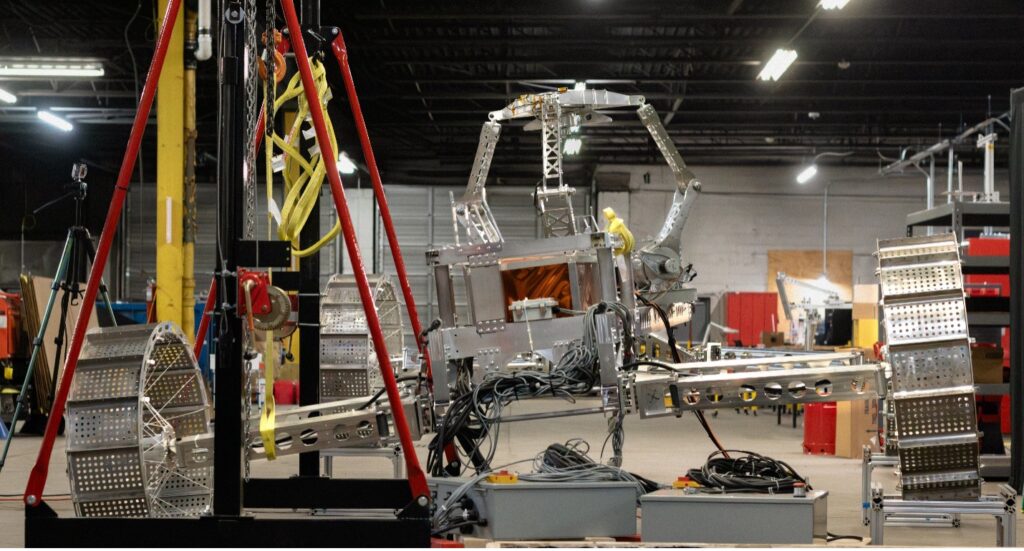
Image Credit: Astrobotic. Astrobotic’s VOLT rover base is tilted at different angles to evaluate the stability of the top-mounted gimbal, which is designed to automatically level a vertical solar array on the lunar surface.
SAN MATEO, CA, March 5, 2026 – Stottler Henke recently completed a successful lunar rover fault detection and diagnosis test campaign at Astrobotic Technology’s facilities in Pittsburgh, Pennsylvania. This test campaign consisted of 36 individual tests across 5 different test types, where Astrobotic and Stottler Henke used a combination of gantry crane with wire ropes, test fixtures, and Astrobotic’s sand pit to validate system performance under a range of simulated anomaly conditions. The test campaign culminated in a fully integrated lunar rover fault detection, diagnosis, and mitigation test that enabled the rover’s control system to react in real time to a soil collapse failure simulated in the sand pit. This sand pit test was the closest of the 5 different test types to simulating actual soil collapse conditions. Across all 36 tests, the team’s rover fault detection and diagnosis software accurately detected all anomalous soil conditions without any false positives.
Stottler Henke’s rover fault detection and diagnosis software, called MAIFLOWER (Modular AI for Faults: Local Watch and Efficient Response), provides generalizable, automatic anomaly detection, diagnosis, and recovery capabilities. MAIFLOWER runs model-based reasoning (MBR) for fault detection and diagnosis and uses data-driven machine learning (ML) to detect early signals of possible anomalies. Because it is very important to avoid falsely attributing a malfunctioning sensor with a real fault, MAIFLOWER also continuously checks the sensor values in its telemetry stream to ensure they are behaving correctly.
The target system for MAIFLOWER is Astrobotic’s Vertical Solar Array Technology Optimized for Lunar Traverse (VOLT), a mobile power generation and transmission platform being developed as part of Astrobotic’s lunar power grid architecture. The VOLT system has a 20-meter-tall solar array, mounted on a robotic gimbal that can relevel the array. Because the height of the solar array increases the potential for tipping the rover, it should be kept within 3 degrees of vertical to maintain structural safety margins.
For this reason, the focus of Stottler Henke’s physical testing was on MAIFLOWER’s ability to detect conditions that could lead to the solar array becoming off level. Specifically, Stottler Henke and Astrobotic collaboratively tested MAIFLOWER in scenarios that simulate soil collapse or soil slipping.
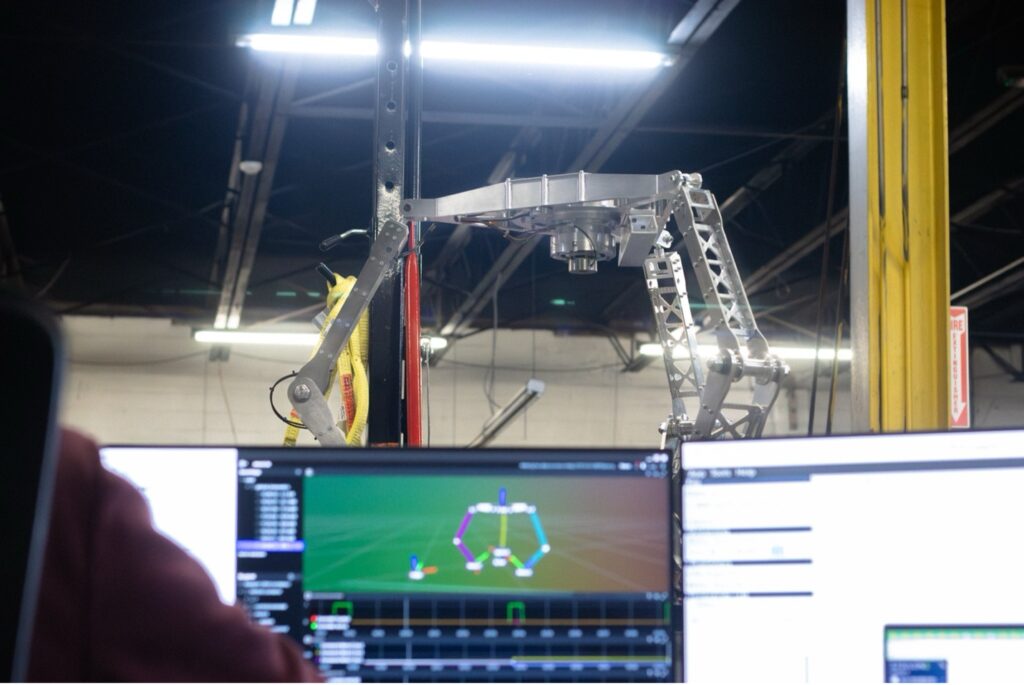
Image Credit: Astrobotic. Stottler Henke is shown running MAIFLOWER, software that monitors the rover’s tilt and angle to determine when adjustments are needed, integrated with Astrobotic’s VOLT gimbal system.
To prepare for the test, Stottler Henke developed and tested MAIFLOWER’s fault detection and diagnosis capabilities in simulation and collaborated with Astrobotic to integrate Stottler Henke’s fault detection API into Astrobotic’s rover software. Meanwhile, Astrobotic implemented a gimbal control system capable of leveling the gimbal to within 0.4 degrees in most cases, and within 1 degree in all cases.
Stottler Henke fully utilized Astrobotic’s test facilities, performing tests, including for soil collapse, in Astrobotic’s large sand pit, using Astrobotic’s engineering model of the VOLT system. During Stottler Henke’s testing phases, the rear wheels of the rover were placed in the sand pit, then the team removed a controlled volume of sand from beneath the wheels, while measuring the amount by which the wheels sank into the sandy soil. This test simulated the soil collapsing from underneath the wheels.
MAIFLOWER detected the soil collapse in all nine repetitions of this test, enabling the VOLT control system to activate the gimbal releveling process to keep the gimbal within one degree of vertical for the duration of the test. It was very important that Stottler Henke’s fault detection system did not flag a nominal condition as anomalous, because that could trigger a gimbal control that could then actually destabilize the rover. However, during the test, the team built in testing windows to check for false positives, and across all 36 tests, MAIFLOWER produced 0 false positives.
MAIFLOWER is being developed in close collaboration between Stottler Henke and Astrobotic. “MAIFLOWER detects anomalous behavior early, helping safeguard critical hardware before damage occurs,” said Sean McGill, Project Manager, Astrobotic Technology. “Our collaboration with Stottler Henke demonstrates the power of true partnership, allowing each of us to leverage our expertise to produce a robust integrated system. This test campaign showcased our hardware and software and validated all of the work put into achieving this new technology,” McGill continued.
Stottler Henke Associates, Inc. applies cognitive modeling, artificial intelligence (AI), machine learning, and other advanced technologies to solve problems that defy solutions using traditional approaches. Stottler Henke develops intelligent software solutions for planning and scheduling, decision support, autonomy, knowledge management and discovery, education and training, and machine learning and classification. Stottler Henke has received numerous awards for its innovative AI solutions. At a White House ceremony, Stottler Henke was one of 18 businesses to receive the prestigious Tibbetts Award for research and development for the U.S. Government, driving innovation and creating new jobs. Email: info@stottlerhenke.com.
Media Contact:
Zinnia Ramirez
650.931.2700
mediacontact@stottlerhenke.com